Chaat is the most reliable crowd-pleaser on an Indian wedding menu, and also the easiest to get wrong. A counter that looked spectacular in the planning meeting can collapse into a forty-minute queue, soggy papdi, and guests drifting back to the buffet. After four decades of running live counters out of Ram Babu Paratha Bhandar in Belanganj, we have learned that the difference between a chaat station guests talk about and one they avoid comes down to a handful of unglamorous operational decisions. This guide covers all of them.
How many chaat counters do you actually need?
The single most common planning error is under-provisioning. Plan one full chaat counter per 200 guests, and treat that as a ceiling rather than a target. A counter staffed by two people can assemble roughly 120 to 150 plates an hour once it is running at pace. At a 400-guest reception where chaat is the headline offering, two counters positioned apart from each other will clear the room comfortably. Put both counters side by side and you have created one queue with two windows, which is not the same thing.
For weddings above 600 guests we split by item rather than duplicating the same menu. One counter handles golgappa and dahi bhalla, another handles hot tikki and kanji bade. Guests self-sort by preference, each queue is shorter, and the kitchen load spreads across two prep lines instead of competing for the same fryer.
Golgappa: the highest-throughput item on any menu
Golgappa, or pani puri depending on where you grew up, is the fastest-moving item we serve. A trained server fills and hands off six to eight puris in the time it takes to plate a single portion of anything else, which is exactly why it belongs at the front of a cocktail hour rather than buried mid-buffet.
Three things determine whether it lands. First, the puris must be stored sealed and opened in small batches — humidity is the enemy, and a tray left open through a hot summer evening will go leathery within twenty minutes. Second, offer at least three waters: a sharp pudina-jeera, a sweeter imli, and a milder option for guests and children who find the classic too aggressive. Third, keep the waters genuinely cold. Chilled pani is the difference between refreshing and flat, and it is the detail most caterers skip because it requires ice management at the counter rather than in the kitchen.
We serve golgappa standing, in leaf bowls or small steel katoris, with no cutlery. Anything that requires a fork slows the line and creates waste.
Aloo tikki and the hot-counter problem
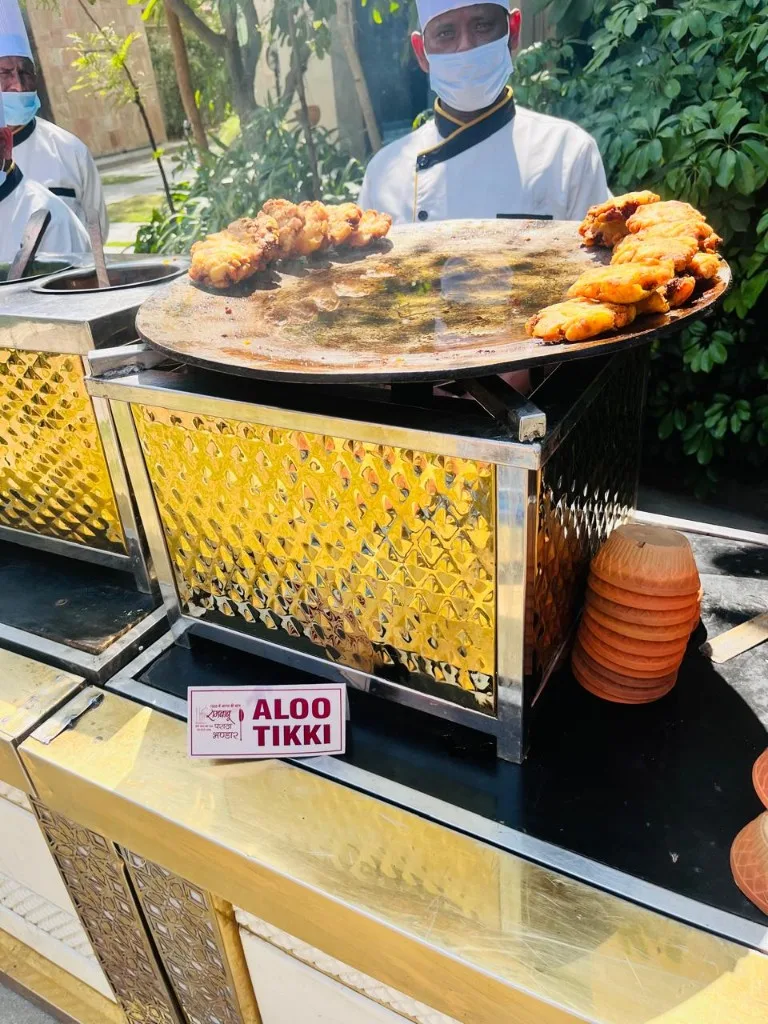
Aloo tikki is where technique shows. The tikki has to be crisp on the outside and soft through the centre, which means it cannot be fried in advance and held. Our counters run a two-stage process: a par-fry in the kitchen, then a final press and crisp on the tawa at the counter as orders come in. Guests see the finish, and the tikki reaches the plate at temperature.
The accompaniments matter as much as the tikki. Whisked dahi at the right consistency, a hing-forward saunth, fresh green chutney made the same day, and a scatter of sev and pomegranate. Where we differ from most caterers is the ratio — we plate the chutneys generously and the sev sparingly, because sev absorbs moisture and turns a two-minute-old plate into a wet one.
Kanji bade and dahi bhalla: the items that separate menus
Kanji bade is the item that tells guests they are eating something regional rather than generic. Fermented mustard kanji, deep and sour and faintly pungent, with soft moong bade dropped in at service. It is not a universal crowd-pleaser and it is not supposed to be — it is the item that older guests from the Braj region will single out and mention to you afterwards.
Dahi bhalla is the safer companion and works everywhere. The technical requirement is soaking discipline: bhalle need to be squeezed and re-soaked so they are saturated but not disintegrating, and they need to be held cold. A warm dahi bhalla is unpleasant in a way that few other chaat items are.
Placement: where the counter goes decides how it performs
Chaat counters succeed or fail on floor plan. The best position is on the natural path between the entrance and the seating, offset from the bar by ten to fifteen feet. Close enough that guests holding a drink drift over, far enough that the two queues do not merge into one obstruction.
Avoid three positions. Do not place a chaat counter directly beside the main buffet — guests will treat it as the first buffet station and the queue will inherit the buffet's pace. Do not place it in a corridor or doorway, which turns a queue into a bottleneck for the whole room. And do not place it behind the stage or mandap, where a third of the room will never find it.
Timing across a long reception
A chaat counter should open when guests arrive and close roughly forty minutes before the main dinner service. Running it in parallel with dinner splits the room and leaves food on both sides.
Within that window we replenish on a fixed cycle rather than on demand — small batches every eight to ten minutes. It sounds inefficient, and it produces marginally more kitchen work, but it is the only way to keep a counter that has been open for three hours tasting like one that opened ten minutes ago. Caterers who top up in large batches when trays run low are trading quality for convenience, and guests notice by the second hour.
Winter menus and the Braj advantage
North Indian wedding season peaks in the cold months, which is fortunate, because winter is when Braj chaat is at its best. Chuda matar — beaten rice tossed with fresh green peas, ghee, ginger and green chilli — is a genuine seasonal speciality that only works when the peas are new. Kanji is a winter preparation by tradition. Hot tikki counters draw crowds on a December evening in a way they never do in May.
If your wedding falls between November and February in North India, build the chaat menu around what the season is actually good at rather than serving the same list you would in summer.
What live chaat counters cost
Indicative per-plate rates for a live chaat counter start from around ₹550 and move up with the number of items, the guest count, and how much of the menu requires finishing at the counter rather than the kitchen. Counters are usually quoted alongside the main menu rather than standalone, since staffing and equipment overlap.
The variables that move the number most are the count of hot items, whether you want regional specialities that require dedicated prep, and the venue's access to power and water at the counter position. A venue that cannot provide either at the floor position you want will need a generator and water haul, and that shows up in the quote.
Putting the menu together
A reliable four-item counter for a 300-guest reception: golgappa with three waters, aloo tikki finished on the tawa, dahi bhalla, and one regional item — kanji bade in winter, papdi chaat otherwise. That is enough variety to feel abundant without spreading the counter staff too thin.
Scale up by adding counters rather than items. Six items on one counter is slower and worse than four items on two counters, every time.
If you are planning a wedding or corporate event and want to see how a counter runs before you commit, we arrange food trials at our kitchen. You can read more about our live chaat counter catering, pair it with live paratha stations for a full street-food format, or look at indicative per-plate pricing across our menu.
Plan Your Event
Ready to bring this to your celebration?
Book a food trial, request our menu, or talk to our team about live paratha and chaat stations for your guest count.