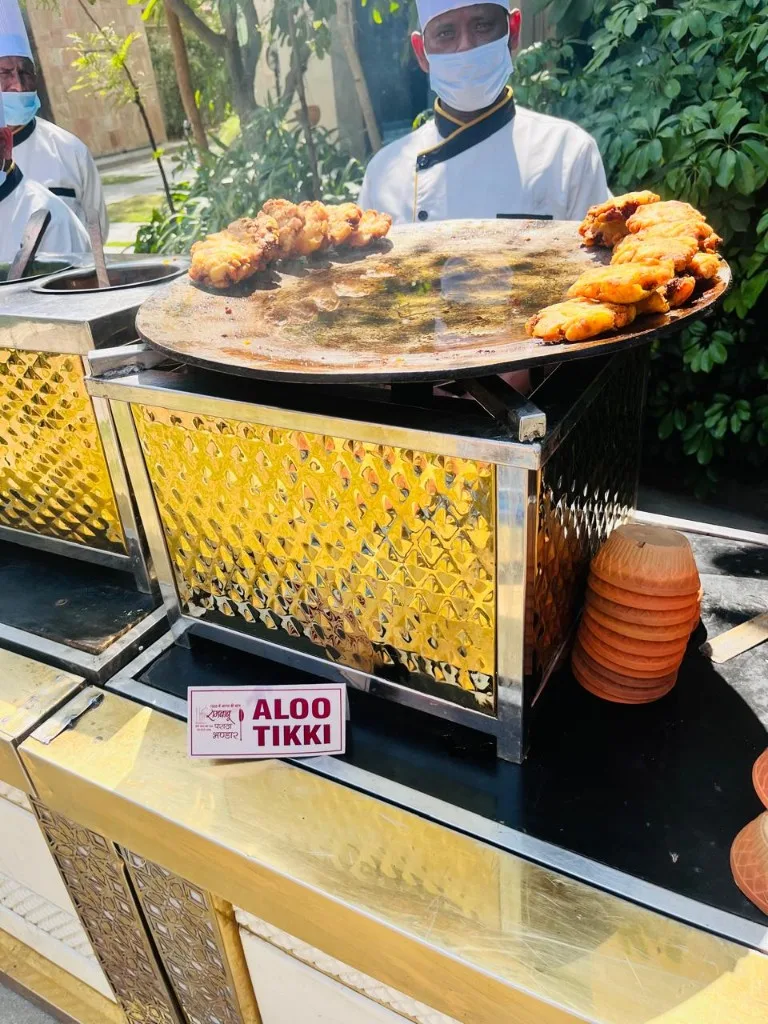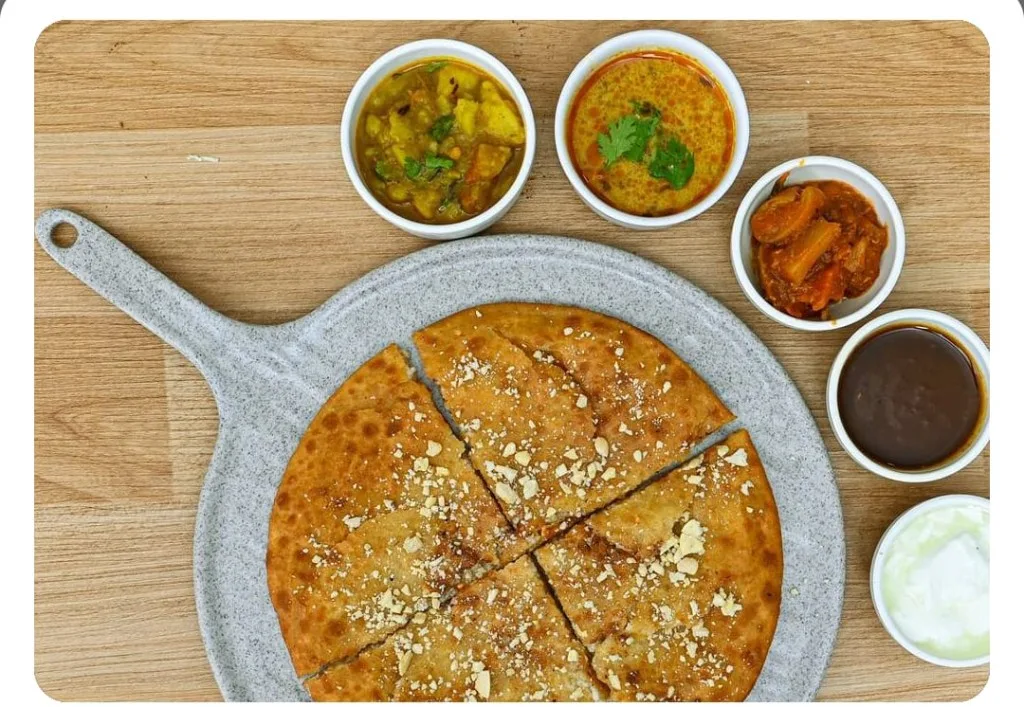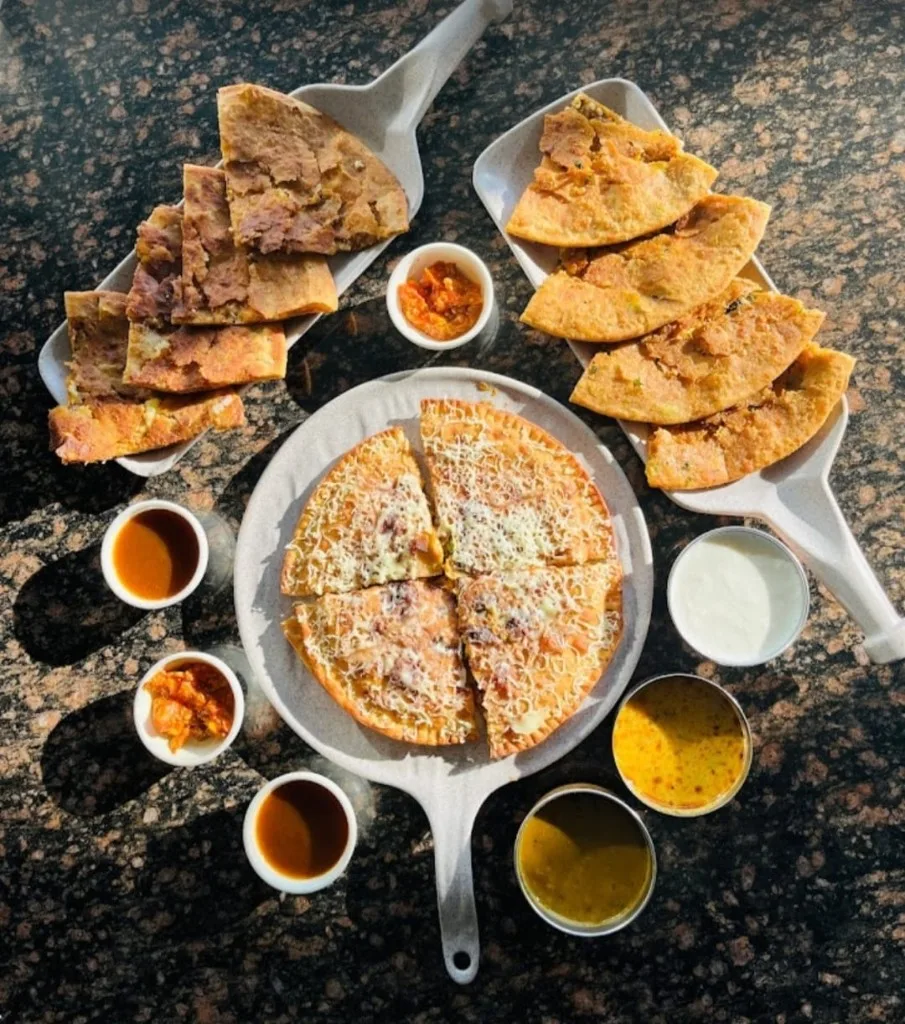
Live counters have become standard at Indian weddings, and most of them are variations on the same few ideas. The paratha station is the one we get asked about most, partly because it is what we are known for, and partly because it solves a problem other stations do not: it produces a hot, substantial, made-to-order dish fast enough to serve hundreds of people without a queue forming.
The ratio that governs everything
One tawa station serves 150 to 200 guests comfortably. That is the number to plan around, and it is worth being conservative with it.
A single station staffed by a roller and a tawa cook turns out roughly 70 to 90 parathas an hour at a sustainable pace. Push harder and quality drops — the tawa gets crowded, the press gets rushed, and parathas start coming off pale. At a 400-guest wedding, two stations plus a shared plating counter is the right configuration. At 800 guests, four stations split across two locations in the venue.
What does not work is one station and optimism. A single tawa at a 500-guest reception produces a queue that becomes the defining memory of the catering, and no amount of skill at the tawa fixes an arithmetic problem.
Where to put the station
Paratha stations want to be visible and reachable, and they want space in front of them. Guests stop to watch the rolling and stuffing, so a counter needs standing room that does not block a walkway.
The best position is along a wall on the route between the entrance and the seating, with clear approach from two sides. Corners look tidy on a floor plan and perform badly — they force a single approach and the queue doubles back on itself.
Keep the tawa station away from the bar. Both draw crowds, and two crowds in the same six feet of floor is one obstruction. Ten to fifteen feet of separation is enough.
Practical requirements to check with your venue
A tawa station needs three things from the venue: a stable surface, gas or an appropriate power supply, and extraction or open air. Indoor stations in enclosed banquet halls need to be positioned with the venue's ventilation in mind, because a tawa running for two hours puts out real heat and smoke.
Water access at or near the counter matters more than people expect — dough work, cleaning down, and hand hygiene all need it. Where a venue cannot provide it at the position you want, we plan a water haul, but it is better to know that at the recce than on the day.
We do a venue walk-through before every wedding for exactly these reasons. Most surprises on an event day are things that a site visit would have caught.
Scheduling across a multi-day wedding
Paratha stations are versatile enough to appear more than once across a wedding without feeling repetitive, provided the format changes each time.
Morning of the haldi or mehendi is the strongest slot. A paratha breakfast counter with sabzi, pickle and chai suits a daytime function and feeds a family that has been up since five.
The reception slot works as a substantial counter alongside chaat and the main buffet. Guests who are not drinking gravitate to it, and it holds attention early in the evening.
Late night, after the dancing, is the slot guests remember most fondly. A single tawa running at midnight, plain and aloo parathas only, no elaborate menu. It costs very little to add and it is disproportionately appreciated.
What to serve alongside
Keep the accompaniments tight. A seasonal sabzi, one sharp pickle, one green chutney, and curd. Butter available on request.
The temptation is to expand the accompaniment table into a spread. Resist it. A paratha station works because it does one thing extremely well, and every additional item at the counter slows the line for no gain in how much guests enjoy it.
Where a paratha station pairs genuinely well is with a chaat counter positioned separately. One hot and substantial, one cold and sharp, and guests move between them. That combination covers a cocktail hour better than either does alone.
Fillings for a wedding guest list
Three fillings is the right number for a wedding counter: aloo as the default, paneer as the richer option, and one seasonal or regional choice — matar in winter, gobi or methi otherwise. More than three slows the roller down as they switch between stuffing bowls, and guests take longer to decide, which compounds.
For a purely vegetarian guest list — which is all of ours, since our kitchen handles no meat or egg — this range covers preferences without needing a longer list. Jain guests can be served without onion, garlic or root vegetables from a dedicated stuffing prepared separately, and it is worth flagging that requirement at booking rather than on the day.
What it costs
Live paratha stations start from around ₹650 per plate as part of a broader menu, moving with guest count, number of stations, and venue logistics. Because staffing and equipment are the main drivers rather than ingredients, the per-plate figure improves at higher guest counts.
A late-night counter added onto an existing booking is the cheapest way to get a live station into a wedding, since the team and equipment are already on site.
To see how a station runs, book a food trial at our kitchen. More detail on live paratha station catering, our wedding catering, and wedding catering if your venue is further afield.
Plan Your Event
Ready to bring this to your celebration?
Book a food trial, request our menu, or talk to our team about live paratha and chaat stations for your guest count.