We have catered state dinners, parliamentary functions, and events attended by heads of government. The food at those events is rarely the difficult part. What makes VVIP and government catering different is everything that surrounds the food: clearance, timing, protocol, and the complete absence of tolerance for improvisation.
Security is the schedule
At an ordinary wedding, the kitchen sets the timeline. At a VVIP event, security does, and everything else adapts.
Staff lists are submitted in advance, often weeks ahead, with identity documents for every person who will be on site. Substitutions on the day range from difficult to impossible, which means you cannot rely on calling in an extra pair of hands. Teams are built with that constraint in mind and staffed with redundancy from the start.
Ingredients and equipment go through screening at entry. That takes time, and it takes time unpredictably. Load-in windows are fixed and they close. A delivery that arrives twenty minutes late may not get in at all.
Access is restricted once the principal is on site. Anything the team needs — equipment, ingredients, replacements — has to be inside the perimeter before that point. There is no running out to the vehicle.
The practical consequence is that VVIP catering is planned backwards from a hard security timeline with substantial buffers, and executed by people who have been briefed on what those constraints mean.
Timing that cannot slip
Government functions run to protocol schedules. Service happens in a defined window, often a narrow one, and often at a time confirmed only shortly before.
We plan for the window to move in both directions. Food that only works in a five-minute serving window is the wrong choice for a state function. Preparations that hold acceptably for thirty minutes and are finished at the last moment are the right one.
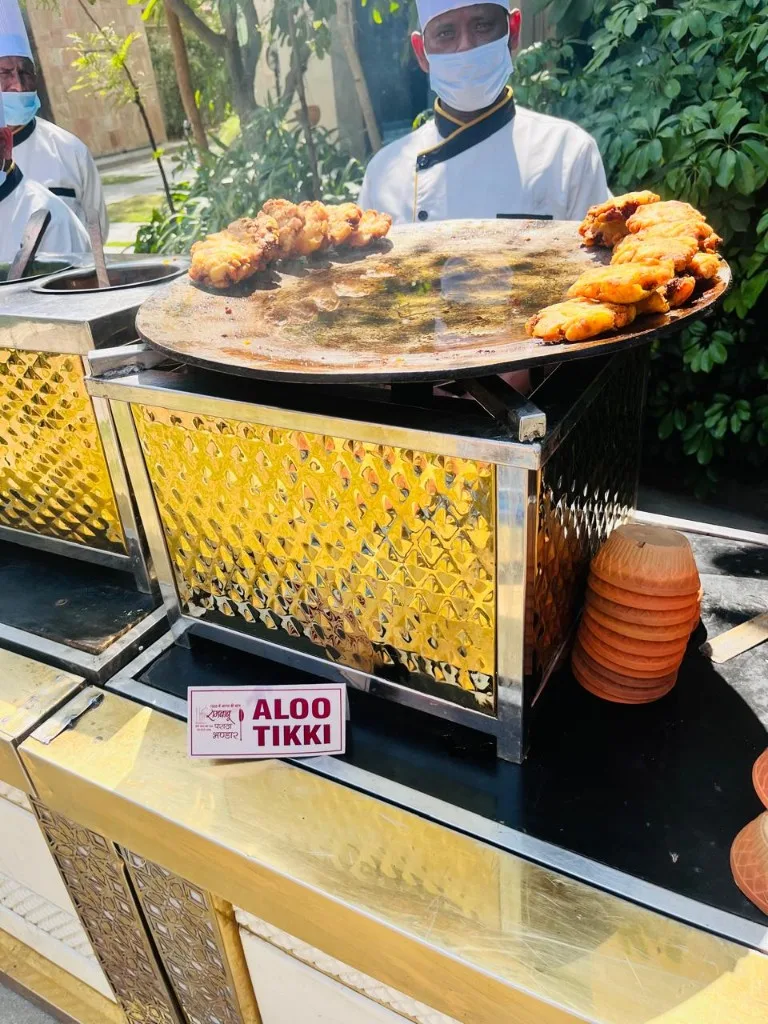
Where live stations are used — and they can be, we have run them at institutional events — the station is staged so it can hold at readiness and go to full service on a few minutes' notice, rather than being brought up to pace on a schedule that may not hold.
Protocol shapes the menu
Menus at official events are governed by considerations that have nothing to do with taste.
Dietary and religious requirements across a delegation have to be met exactly, not approximately. Our kitchen being entirely vegetarian removes the largest category of risk, which is one reason we are approached for these events. Jain requirements without onion, garlic or root vegetables are handled from separately prepared stock.
Regional and diplomatic sensitivity matters. A state dinner menu is a piece of hospitality with meaning attached, and the choices are made deliberately.
Presentation follows protocol rather than trend. Formal, restrained, consistent across every cover. This is not the context for asymmetric plating or informal serveware.
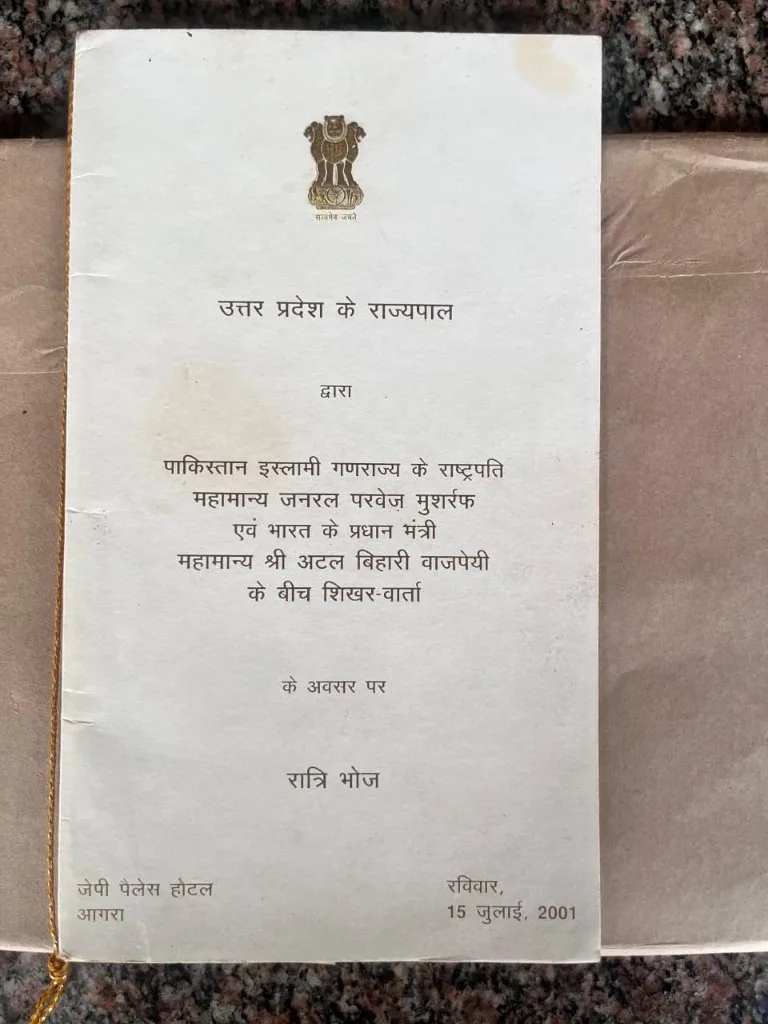
Menu cards are frequently part of the record. Some of ours are the only surviving documentation of events we catered, which is a reason to take them seriously as objects.
Traceability and hygiene
Documentation at institutional events goes well beyond ordinary standards. Sourcing records for ingredients. Named staff with clearance. In some cases, retained samples of every dish served.
This is normal and it is reasonable. It also means the sourcing has to be tight enough to document — established suppliers with consistent records, not whoever had good produce that morning. Kitchens that operate on informal sourcing cannot pass this kind of scrutiny, regardless of how good their food is.
Staff briefing and discipline
Service staff at a VVIP event need to know more than their service duties. Where they may and may not go. Who they may and may not approach. What to do when a security instruction contradicts a service instruction — the answer is always to follow security.
The behavioural requirement is discretion. No photographs. No conversation about who attended or what was served. For a family business this is straightforward; it is a matter of instructing the team clearly and only bringing people who have been briefed.
What it takes to be considered
Government and institutional catering is largely a referral and track-record business. The credentials that matter are prior events completed without incident, the ability to satisfy clearance requirements, sourcing that stands up to documentation, and a team that has worked under these conditions before.
Our own record here goes back decades: a summit dinner in 2001, a state dinner in 2005, a parliamentary Golden Jubilee function, and institutional events since. The documentation from several of those is in our portfolio.
What transfers to ordinary events
The useful part of all this is that the discipline it demands does not switch off. Planning backwards from a hard deadline, building staffing with redundancy, sourcing that can be documented, and briefing teams properly are habits, and they improve a 300-guest wedding as much as they do a state function.
More on our catering services, corporate catering nationwide, and our history.
Plan Your Event
Ready to bring this to your celebration?
Book a food trial, request our menu, or talk to our team about live paratha and chaat stations for your guest count.